Sustainable Education
School infrastructure design for remote, underserved communities.

Sustainable Education members tackle real-world design challenges, rethink what sustainable building can look like, and help create spaces where students can learn, grow, and thrive.
- 17People
- 3Leads
- 3Partners
About
Sustainable Education is a hybrid research, design and implementation group that designs schools for remote, underserved communities, with United World Schools (UWS) as its main partner. With local partners, it develops buildings that use available materials, can be built by local labor and respond to the climate and culture of the place, treating design as a tool for long-term community development.
- Partners
- United World Schools (UWS), primary partner
- Local students, teachers and community members
- Other CUSD teams working on landscape and infrastructure
Current projects
This semester, we're continuing to develop a K–8 school in Humla, Nepal, in partnership with United World Schools. Our work focuses on researching community customs and needs, exploring locally available building materials, analyzing climate and environmental conditions, and developing design strategies that make the school safe, sustainable, and feasible to build in a remote setting.
How we design a school
01 Study the site
Climate, the materials on hand, what can actually be built there, and the hazards.
02 Build local
Vernacular systems like rammed earth, stone masonry, bamboo and gabion walls.
03 Improve it
Passive solar design, daylight, thermal mass, and solar panels where they make sense.
04 Listen
Workshops, translated surveys and feedback sessions, with local labor in the build.
Join the team
Who we're looking for
Seeking students with skills in architecture, CAD, Rhino, environmental design, landscape architecture, community research, empathy fieldwork, systems thinking skills. Both technical design skills and design-thinking abilities are valued, especially stakeholder engagement, material sourcing, construction logistics, and translating community needs into practical design solutions.
Our Work
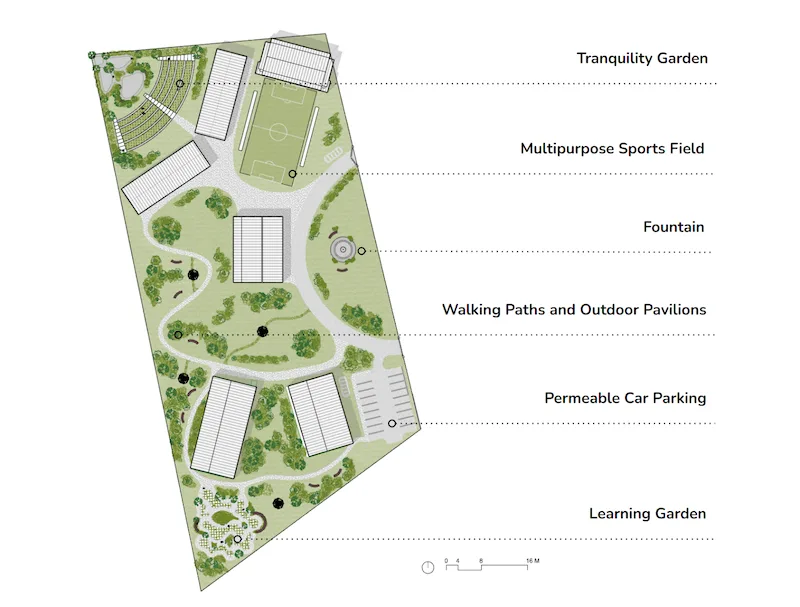
Project details
The problem
In extremely remote regions like Humla, Nepal, access to quality school infrastructure is limited by geography, extreme climate, scarce material availability, unreliable transportation networks, and exposure to natural hazards such as flooding and landslides. Conventional architectural approaches often fail in these contexts due to their reliance on external supply chains and technical expertise.
Approach
The team's methodology is grounded in contextual responsiveness. Projects begin with site-specific climate analysis, material availability studies, construction feasibility research, and hazard assessments. Rather than importing external architectural ideals, the team adapts vernacular building systems such as rammed earth, stone masonry, bamboo, and gabion walls, combined with targeted technical improvements including passive solar design, daylight optimization, thermal massing, and photovoltaic integration where viable. Community engagement is central: the team conducts workshops, translated surveys, and iterative feedback sessions with students, teachers, and local stakeholders. Where possible, local labor is employed and trained during construction.
This semester
Produced research documents, environmental analyses, and design guidelines supporting the K-8 school project in Humla, Nepal. The team has served as an internal knowledge hub within CUSD, informing adjacent project teams. Community engagement processes have been built into the design workflow, including translated feedback mechanisms and local labor integration.
Next steps
Continue development of the Humla, Nepal K-8 school project. Refine replicable frameworks for educational infrastructure that can be applied to future projects in similarly constrained contexts. Deepen community engagement processes and build on knowledge transfer during construction phases.
Meet the team
Leads

Andrew Wheat
Co-Lead

Hanna Obel
Co-Lead

Charlie McCauley
Co-Lead


Members

Alexa Liu

Alfred Nazhiyampara

Annika Schadt

Arman Daragahi

Ella Kim

Ivy Lo

Juanita Londono

Kennan Chockalingam

Maple Ding

Nawat Nhan

Noah Lindemann

Sarah Adler

Shaista Mallik
Sirietta Simoncini


